
ENVIRONMENTAL
- Treatment and reduction of froth and muds straight at the source (3RV-E : reduction/reuse/recycling/valorisation/elimination)
- Elimination of odors coming out from the septic tank
- Direct and indirect reduction of greenhouse gases (with the SeSana treatment, there is no pumping/transportation/treatment or disposal of organic matter)
- The treatment prevents clogging of the septic field (no expensive decontamination or rebuilding of a septic field)
- Significant increase of the installations and septic fields’ useful life
- Increase of your installation’s treatment capacity without the need to expand
- Control and take action by yourself according to your needs (odor/shock treatment)
- In the future, the need to empty the septic tank could eventually be eliminated
REGULATION
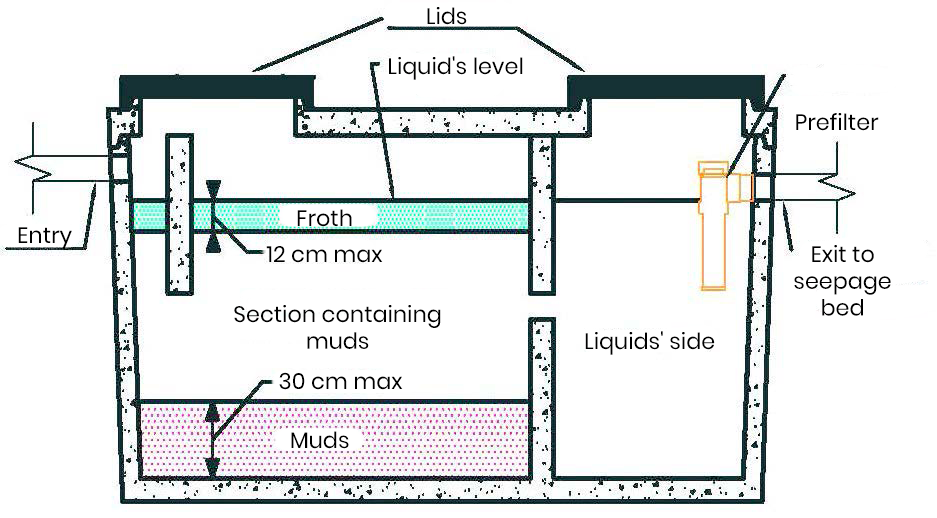 THE MEASURING OF MUDS
- article 13 – evacuation and treatment of wastewaters from isolated residences • A septic tank targeted at the second paragraph of the article 9.1, at the article 10 or at the article 11 that is used on a seasonal basis must be emptied once every 4 years. • A septic tank targeted at the second paragraph of the article 9.1, at the article 10 or at the article 11 that is used all year long must be emptied once every 2 years. • However, in the case where a municipality provides the emptying of septic tanks, a septic tank could be emptied either under the provisions of the first and second paragraphs or according to the measurements of froth and muds. ◦ In this case, a septic tank must be emptied when the thickness of the froth layer is equal or superior to 12 cm or when the thickness of the muds layer is equal or superior to 30 cm.
THE MEASURING OF MUDS
- The measuring of muds and froth is a method that is inexpensive, highly efficient and that allows substantial savings. It answers to the first R of the 3RV-E, reduction at the source, and allows to reduce the emission of greenhouse gases by lowering the truck flow and the amount of muds needing to be treated. Ref : https://www.environnement.gouv.qc.ca/eau/eaux-usees/residences_isolees/gestion-optimale-fosses-septiques.pdf article 6.3
- Let’s remind that the Québec policy described by the MELCC is to reduce of 270 000 t éq.CO2 the emissions of GEG in 2030. Therefore, the department promotes managing waste by recycling and in situ waste valorisation and aims to ban disposal by landfill or incineration of putrescible organic waste.